Blog
Why the Same Nicotine Strength Tastes Different Across JUUL, RELX, and Other Pod Devices

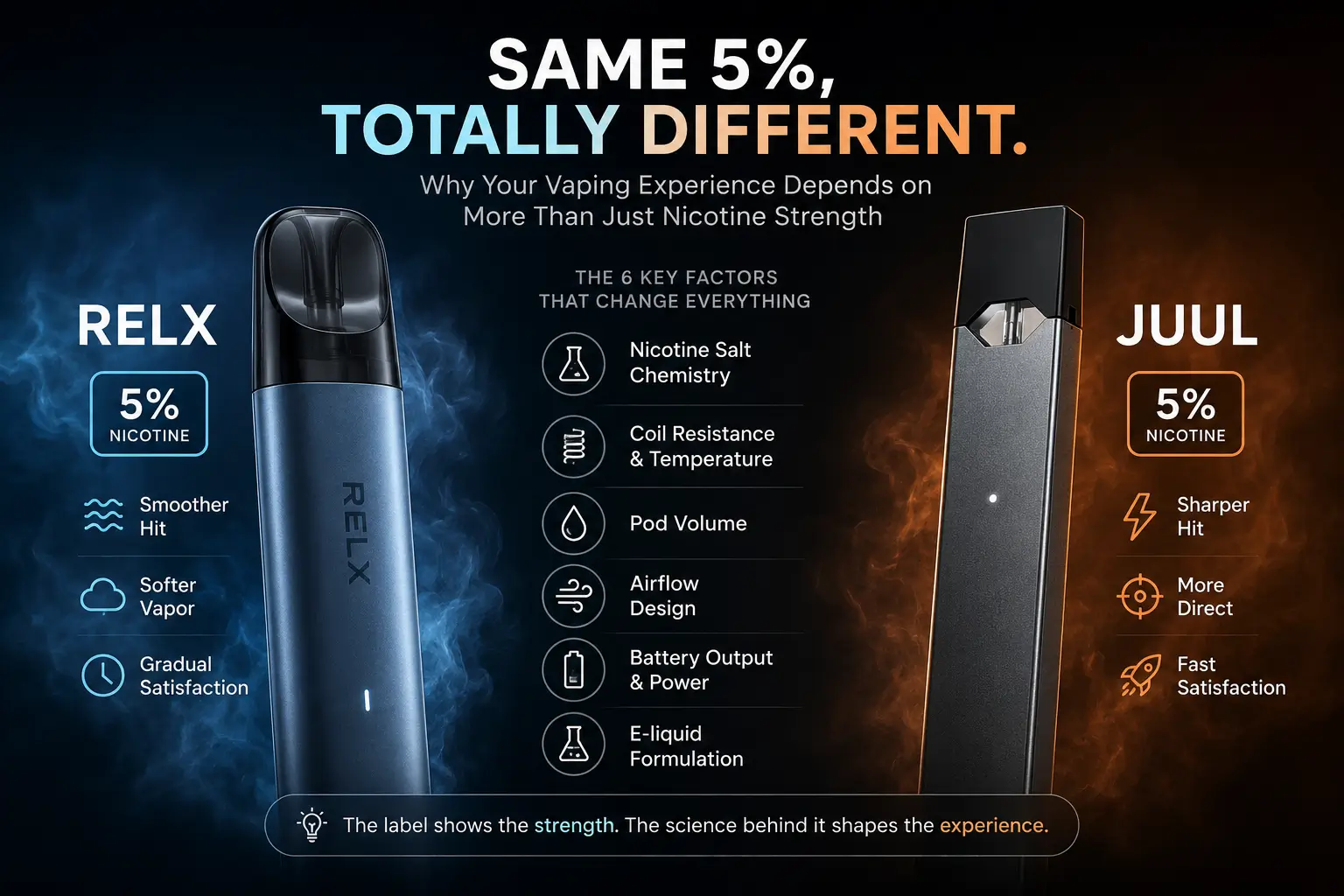
You pick up a RELX pod at 5% and switch to a JUUL at the same 5%. Same strength, same habit, but the experience is completely different. One feels sharp and direct. The other feels smooth, almost understated. Neither is broken. Neither is mislabeled. The number on the pod is accurate. The difference runs deeper than the label.
What actually reaches your throat, your lungs, and your bloodstream depends on at least six variables that have nothing to do with the percentage printed on the packaging. Acid chemistry, coil temperature, pod volume, liquid formulation, airflow geometry, and battery output all interact to produce the nicotine sensation you feel on a given draw. Understanding how each variable works and how they combine differently across JUUL and RELX gives you real control over your experience.
The Label Doesn’t Tell the Full Story
mg/mL vs. Percentage: Why the Same Number Means Different Things
Nicotine strength is expressed two ways on pod packaging: as a percentage (e.g., 5%) or as a concentration in milligrams per milliliter (e.g., 50 mg/mL). These two figures describe the same thing: 5% and 50 mg/mL are equivalent. So far, straightforward.
The problem is that percentage tells you concentration, not delivery. Two pods at 50 mg/mL will not deliver the same amount of nicotine per puff if they differ in pod volume, coil temperature, or puff resistance. A pod with 2 mL of 50 mg/mL e-liquid contains 100 mg of total nicotine. A pod with 0.7 mL at the same concentration contains only 35 mg. The label reads identically. The actual nicotine available per session is nearly three times different.
Pod volume is almost never mentioned on consumer packaging, but it is one of the biggest determinants of how long the nicotine satisfaction lasts and how concentrated each individual puff feels as the pod depletes.
How Nicotine Bioavailability Differs Between Brands at Identical Strengths
Bioavailability refers to how much of the nicotine in the vapor actually enters your bloodstream. Not all nicotine in a pod is absorbed. The proportion that is depends heavily on the chemical form of the nicotine and the temperature at which it is delivered.
Nicotine in freebase form has a high pH (~8), which makes it harsher at high concentrations but also causes it to absorb more slowly through mucous membranes. Nicotine in salt form has a lower pH, which allows faster absorption even at high concentrations without the harshness. If you want to understand how nicotine salt absorption works in detail, our guide for UAE pod users covers the full chemistry. This means a 35 mg/mL nicotine salt formulation can deliver a more immediate and satisfying hit than a 50 mg/mL freebase formulation, despite having a lower label number.
Brands differ in which nicotine form they use, which acid they select to create the salt, and what concentration they target. The label tells you the concentration. It does not tell you the form, the acid, or the absorption speed.
Nicotine Salt Chemistry: The Acid Behind the Taste
Benzoic, Citric, and Lactic Acid: How Each Changes What You Feel
Nicotine salt is not a single product. It is any combination of nicotine with an organic acid, and the acid chosen directly determines the pH of the final liquid, the smoothness of the vapor, the flavor character, and the speed of nicotine uptake.
Benzoic acid is the most widely used and was the formulation that made JUUL commercially dominant. It brings the pH of nicotine down to approximately 6.5, close to neutral, which produces a noticeably smooth throat hit with rapid nicotine absorption. The aftertaste is largely neutral, and coil wear is standard. This is why JUUL’s delivery feels direct and efficient without being chemically harsh.
Citric acid produces a sharper initial hit that softens quickly. When citrus-flavored e-liquids are added to a citric acid nicotine salt base, the combined acidity creates a distinctive first-puff sharpness followed by a tart, slightly scratchy aftertaste. The flavor intensity is higher, which makes citric acid formulas popular in fruit-forward pod ranges.
Lactic acid produces the smoothest hit of the three. The pH drop is gentler, absorption is slightly slower, and the overall sensation is mild even at 50 mg/mL. RELX’s “SuperSmooth” positioning is built in part on lactic acid formulations in select pod lines, which explains why experienced JUUL users often find RELX feels underpowered. The delivery is genuinely softer, not weaker.
Salicylic acid sits at a pH of around 4.8, making it the most acidic of common nic salt bases. It produces a distinctive flavor note at higher concentrations and is used less frequently, typically in niche or specialist pod brands.
Why Higher Nic Salt Concentration Can Still Feel Milder Than a Lower One
This is the counterintuitive part that most label comparisons miss entirely. A 50 mg/mL lactic acid salt pod can feel smoother and less impactful than a 30 mg/mL benzoic acid pod. Two variables are responsible:
pH level determines throat harshness. Lower pH (more acidic) means smoother airway delivery regardless of concentration. A higher-acid formula at 50 mg/mL can feel gentler than a lower-acid formula at 30 mg/mL.
Absorption speed determines perceived strength. Benzoic acid facilitates faster bloodstream uptake, which creates a more immediate nicotine response, the sensation of a “hit.” Lactic acid absorbs more slowly, producing a gradual satisfaction rather than an acute spike. Users who associate nicotine satisfaction with a sharp, fast response will perceive a lactic acid formula as weaker even when the concentration is higher.
The practical result: comparing brands by percentage alone is meaningless without knowing which acid was used.
Your Device Hardware Is Doing More Than You Think
Coil Resistance and Vapor Temperature: The Hidden Taste Variable
Every pod device contains a coil, a resistive heating element that vaporizes e-liquid when current flows through it. Understanding coil resistance and how it works is one of the most overlooked factors when comparing brands. Coil resistance (measured in ohms, Ω) controls how much power the coil draws, which determines how hot it gets and therefore how thoroughly the e-liquid is vaporized on each puff.
High-resistance coils (1.0Ω to 2.5Ω) operate at low wattages, typically 8W to 15W. They produce cooler vapor, which preserves subtle flavor notes and reduces throat harshness. They are well-matched to nicotine salt formulas and MTL draws. JUUL pods operate at approximately 1.6Ω. The result is a measured, consistent vapor temperature that delivers nicotine efficiently without overheating the liquid.
Lower-resistance coils (0.6Ω to 1.0Ω) run hotter, produce more vapor volume per puff, and extract flavor more aggressively. They amplify sweetness and fruit notes but also amplify harshness at high nicotine concentrations. Devices using ceramic coils, common in RELX, distribute heat more evenly across the wick surface, reducing dry hit risk and providing a more consistent temperature curve across the life of the pod.
The same e-liquid formula drawn through a 1.6Ω coil and a 0.8Ω coil will produce noticeably different nicotine intensity, flavor profile, and throat sensation. Resistance is the variable almost no marketing material mentions.
Airflow Design and MTL Draw Differences Across Pod Brands
Mouth-to-lung (MTL) draw resistance varies significantly between pod devices, even devices in the same product category. Tighter airflow means the user inhales slower, holds vapor in the mouth longer before drawing to the lungs, and receives a more concentrated nicotine dose per breath. Looser airflow means higher vapor volume per puff but a more diluted nicotine concentration reaching the lungs on each draw.
JUUL’s pod design prioritizes a tight, cigarette-like draw. The restricted airflow produces a familiar sensation for former smokers and ensures nicotine delivery is concentrated. Devices like the RELX Infinity 2 offer slightly more airflow variability, producing a somewhat airier draw that reduces harshness but also slightly reduces the per-puff nicotine intensity.
This is not a flaw in either system. It is a design philosophy: one is optimized for cigarette replacement and the other for daily vaping comfort. The consequence for the user is that switching between them requires adjustment, not just tolerance.
How Pod Volume and Puff Count Affect Nicotine Intensity Per Draw
This is the gap no competitor content addresses clearly. Pod volume determines how many puffs a pod delivers, and puff count directly affects how concentrated each draw feels.
A JUUL pod holds approximately 0.7 mL of e-liquid at 18 mg/mL (UAE-compliant concentration), rated for approximately 200 puffs.
A RELX Pod Pro holds approximately 1.9 mL at 30 mg/mL (in the UAE market), containing 57 mg of total nicotine, rated for approximately 500 to 600 puffs. Per-puff nicotine delivery works out similarly in absolute terms, but the draw volume, vapor temperature, and acid type mean the experience of that nicotine per puff is completely different.
When users describe RELX as “smoother” and JUUL as “stronger,” they are often describing acid chemistry and coil temperature differences, not a true difference in nicotine content.
What’s Inside the E-Liquid Formula
How PG/VG Ratio and Flavor Additives Change Nicotine Sensation
Every pod e-liquid is built on a base of propylene glycol (PG) and vegetable glycerin (VG). The ratio between them determines vapor thickness, throat sensation, and flavor carrier efficiency.
PG is thin, carries flavor efficiently, and produces a noticeable throat hit. High-PG formulas (60:40 PG/VG or higher) are well-suited to high-resistance coils and tight MTL draws, which describes almost every major pod system. JUUL pods use a high-PG base, contributing to their characteristic direct throat delivery.
VG is thicker, produces denser vapor clouds, and softens the throat hit considerably. Higher VG ratios are more common in sub-ohm devices and open-system pods. Most closed-system pods maintain a higher PG ratio to ensure correct wicking through tight pod geometries, but the exact ratio varies by brand and by flavor line within a brand.
A 70:30 PG/VG formula at 30 mg/mL can feel harsher than a 50:50 formula at 50 mg/mL, purely because PG amplifies throat sensation regardless of nicotine concentration. Brand-to-brand taste differences often have more to do with PG/VG ratio than with nicotine strength.
How Flavor Concentrates Load, Mask, or Amplify Nicotine Perception
Pod e-liquids contain flavor concentrates, often between 10% and 20% of the total liquid volume. The presence of dense, sweet, or cooling flavor concentrates physically masks nicotine harshness at the sensory level.
A heavily flavored RELX fruit pod at 50 mg/mL can feel markedly smoother than an unflavored or lightly flavored nicotine salt of the same strength, not because the nicotine formula differs, but because the flavor compounds occupy the same sensory receptors that would otherwise register the nicotine burn.
Menthol and cooling agents (WS-23, WS-3) create a vasodilatory effect in the airway that reduces perceived irritation. This is why almost every pod brand’s menthol or mint SKU feels smoother than its tobacco equivalent at the same nicotine strength. The nicotine chemistry is identical; the sensory overlay is doing the work.
This has a practical implication: users who switch from a fruit or mint pod to a tobacco pod at the same stated strength often perceive the tobacco variant as significantly stronger and sometimes reduce their nicotine level unnecessarily.
Sweeteners and Additives That Change How Nicotine Registers on the Palate
Sucralose is the most common sweetener in pod e-liquids. It does not change the nicotine chemistry, but it does alter sensory perception by engaging taste receptors in a way that competes with the sensation of nicotine harshness. Heavily sweetened pods, common in dessert and candy flavor lines, effectively blunt the perceived edge of high-concentration nicotine.
Additionally, sweeteners accelerate coil degradation, which reduces vapor temperature consistency over the pod’s lifespan. A fresh pod and a 75%-depleted pod from the same batch can produce noticeably different nicotine sensations, partly due to coil coating from sucralose oxidation.
Brand-by-Brand Breakdown: Same Strength, Different Experience
JUUL: Coil Resistance, Acid Type, PG/VG, Pod Volume
| Variable | JUUL |
|---|---|
| Coil Resistance | ~1.6Ω |
| Nicotine Acid Type | Benzoic acid |
| PG/VG Ratio | High PG (~70:30) |
| Pod Volume | 0.7 mL |
| Nicotine Strengths (UAE) | 18 mg/mL |
| Delivery Profile | Fast-absorbing, direct hit, neutral aftertaste, cigarette-like draw |
JUUL’s design philosophy is cigarette replacement first. If you want to understand legal availability and compliance for JUUL in the UAE, including age restrictions and regulatory guidelines, that guide covers everything you need to know before buying. The high-resistance coil, tight airflow, and benzoic acid formula combine to deliver a fast, efficient nicotine hit that closely mimics the timing and intensity of a cigarette. The small pod volume means each pod is consumed relatively quickly, maintaining nicotine freshness per session.
RELX: Coil Resistance, Acid Type, PG/VG, Pod Volume
| Variable | RELX |
|---|---|
| Coil Resistance | Ceramic coil, ~1.2Ω to 1.8Ω depending on series |
| Nicotine Acid Type | Lactic acid (primary, select lines) |
| PG/VG Ratio | Balanced (~50:50 to 60:40) |
| Pod Volume | 1.9 mL (Pod Pro / Pod Pro 2) |
| Nicotine Strengths (UAE) | 1.55%, 3%, 5%, 18 mg/mL |
| Delivery Profile | Gradual absorption, smoother throat, flavour-forward, wider flavour range |
RELX’s ceramic coil technology distributes heat more evenly than traditional wire coils, producing consistent vapor temperature from first puff to last. To understand exactly how this technology prevents inconsistent hits and leakage, see our breakdown of how RELX’s ceramic coil technology works. Both the RELX Infinity 2 and RELX Artisan are compatible with RELX Pod Pro and Pod Pro 2, but their ceramic coil systems and airflow geometry differ from JUUL’s hardware approach.
Why the Same Pod Hits Differently on Different Days
Battery Output Drop Across Charge Cycles and Its Effect on Vapour Heat
A fully charged pod battery delivers maximum voltage to the coil, producing peak vapor temperature and optimal e-liquid vaporization. As battery charge depletes, typically below 30%, voltage output drops, coil temperature falls, and vapor production decreases. The result is a noticeably weaker nicotine sensation from the same pod and the same e-liquid, with no change in concentration.
This effect is more pronounced in older batteries that have gone through multiple charge cycles. Lithium-ion battery capacity degrades with each cycle. A JUUL or RELX device used for six months will produce measurably lower peak voltage than it did when new, and if your pods taste weaker or burnt over time, battery degradation is one of the first things to rule out before assuming pod quality is the issue.
Users who feel their device has “gotten weaker” over time are often experiencing battery degradation, not tolerance buildup.
Pod Seal Degradation and Nicotine Consistency Over Time
Pod seals prevent e-liquid from oxidizing and prevent air infiltration that can alter the nicotine chemistry. As pods age, whether opened and in use or unopened past their shelf date, seal integrity degrades. Oxidation converts nicotine to cotinine and nicotine oxides, reducing active nicotine concentration and producing a stale or bitter flavor note.
This is why a fresh pod from a newly opened pack feels consistently stronger and cleaner than the last pod from a pack that has been open for two weeks. The same batch, the same formulation, but degraded nicotine from exposure.
Temperature Sensitivity of Nic Salt Formulas in Storage
Nicotine salt e-liquids are temperature-sensitive. Storage above 25°C, common in UAE conditions, accelerates both nicotine oxidation and flavor compound breakdown. A pod stored in a car, a windowsill, or a warm pocket for several hours will deliver a different experience than a pod stored at room temperature.
Lactic acid formulations common in RELX are particularly sensitive to thermal degradation compared to benzoic acid equivalents, as the lower-acidity environment provides less chemical stability for the nicotine molecule under heat stress.
How to Recalibrate When Switching Between Pod Brands
Signs Your Current Strength Doesn’t Match Your Device
The most common mismatch signals:
- Persistent dry hits or burnt taste: Wattage or coil temperature is too high for your e-liquid viscosity; common when switching to a higher-PG liquid in a device designed for balanced PG/VG.
- No throat sensation despite high label strength: likely a lactic acid formulation or high flavor concentrate masking the hit; the nicotine is present, but sensory perception is blunted.
- Dizziness or headaches after short sessions: Nicotine strength is too high for the device’s absorption speed; often occurs when a RELX user switches to a JUUL-equivalent benzoic acid device at the same stated percentage.
- Craving remains despite frequent puffing: the device is under-delivering due to battery depletion, low coil temperature, or a very gradual-absorption acid type.
Stepping Up or Down When Moving from JUUL to RELX (or Vice Versa)
Switching from JUUL to RELX: Because RELX’s lactic acid formula and slightly lower coil temperature produce a softer, slower nicotine delivery, most JUUL users at 18 mg/mL will need to step up to RELX’s 3% (30 mg/mL) or 5% (50 mg/mL) to achieve comparable satisfaction. Starting at RELX 5% and stepping down if needed is the practical approach. A full cost and usage breakdown is available in our RELX pod vs JUUL pod comparison for daily users.
Switching from RELX to JUUL: The reverse applies. JUUL’s benzoic acid formula and tighter draw deliver nicotine more sharply. A RELX 5% user switching to JUUL 18 mg/mL may find the sensation stronger than expected; starting at a lower session frequency and increasing as needed is sensible.
UAE Market Note: Regional Nicotine Caps and What They Mean for Your Choice
The UAE applies nicotine concentration regulations to vaping products sold in the market. JUUL’s global formulation at 59 mg/mL (5%) is not available at that concentration in the UAE. The marketed strength is 18 mg/mL in compliance with regional guidelines.
UAE Nicotine Strength Comparison
| Brand | UAE Available Strengths | Global Standard |
|---|---|---|
| JUUL | 18 mg/mL only | 59 mg/mL (5%) globally |
| RELX | 1.55%, 3%, 5%, 18 mg/mL | Varies by market |
This means UAE buyers comparing JUUL and RELX are not comparing equivalent concentration tiers. A RELX 5% pod in Dubai is a significantly higher-concentration product than the locally available JUUL, which adds another dimension to why the same-strength comparison breaks down for UAE consumers specifically.
When selecting a pod brand in the UAE, verify the locally stocked strength before ordering. Browse the full range of JUUL 2 pods and RELX pods available in Dubai with UAE-compliant nicotine strengths confirmed on each product listing.
Frequently Asked Questions
Is 5% nicotine the same strength in all pod devices?
No. The nicotine percentage may be the same, but device design and nicotine formulation can make the experience feel very different.
Why does RELX feel smoother than JUUL at the same percentage?
RELX uses different nicotine chemistry and ceramic coil technology, creating a smoother and less harsh inhale than JUUL.
Does pod size affect how strong the nicotine feels?
Yes. Pod size, puff count, and device settings can influence how much nicotine feels delivered per session.
Can a low battery change how my pod tastes?
Yes. A low battery can produce cooler vapor, which may reduce flavor intensity and nicotine satisfaction.
Which pod brand delivers nicotine closest to a cigarette?
Many users find JUUL feels closest to a cigarette because of its stronger throat hit and faster nicotine delivery.